
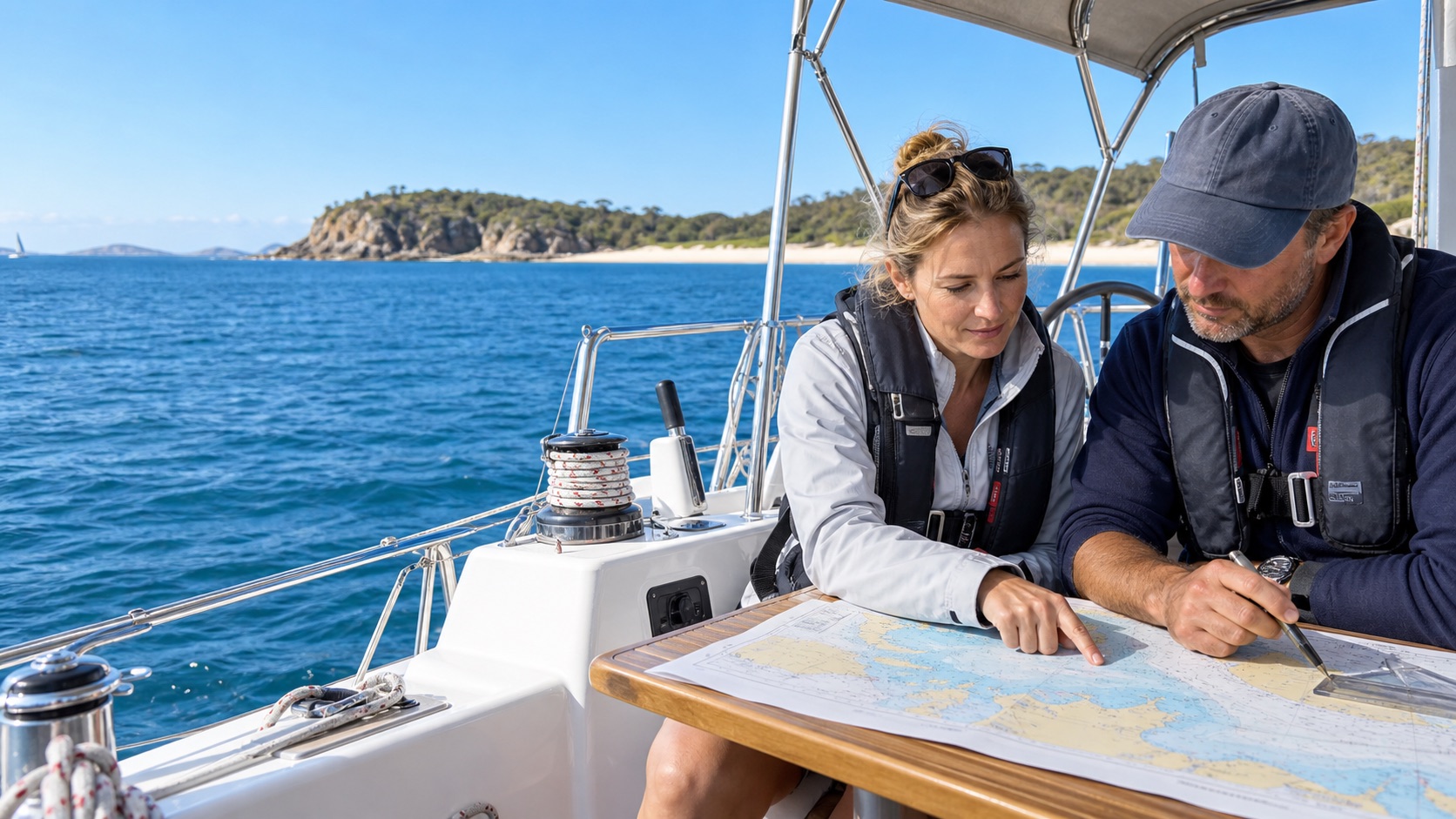
Nationally consistent, genuinely rigorous, and built on a currency no course can sell you: logged, witnessed days at sea. Everything below is issued under Marine Order 505 and delivered through the MAR training package.
The deck ladder
The progression runs General Purpose Hand, then Coxswain Grades 3, 2 and 1, then Master at 24, 45 and 100 metres. There is a separate Master (Inland Waters) stream, a separate engineering stream, and a separate sail stream. Every certificate below is a near coastal certificate — domestic Australian waters, not international.
1 Coxswain Grade 2 — MAR10424
Certificate I in Maritime Operations. Command a vessel under 12 m with an inboard under 100 kW, or any outboard. Sheltered waters within 5 nm of shore, or within 3 nm of a parent vessel as a tender. 10 days with a task book, or 50 without Uniquely, recreational sea time counts at this grade. Medical, HLTAID011, age 16.
2 Coxswain Grade 1 — MAR20324
Certificate II in Maritime Operations. Command a vessel under 12 m with an inboard under 500 kW, or any outboard, in inshore waters. The workhorse ticket of the Australian charter, dive and fishing industries. 30 days with a task book, or 150 without Commercial vessels of 5 m or more. SROCP required. ~10 days of course, ~$3,290.
3 Master up to 24 m — MAR30924
Certificate III in Maritime Operations. Master of vessels to 24 m, or chief mate and watchkeeper on vessels to 45 m in the EEZ and 100 m inshore. 120 days with a task book, or 360 without Vessels 7.5 m or more, at least half commercial. LROCP required. ~20 days of course, ~$4,290.
4 Master up to 45 m — MAR40324
Certificate IV in Maritime Operations. Master to 45 m in the EEZ, to 100 m inshore. This is where the difficulty steps up sharply. 180 days with a task book (120 in charge of a watch), or 360 without (240 as OOW) Held while already carrying Master <24 m or Mate <80 m, on vessels of 12 m or more.
AMSA oral examination required.
E Marine Engine Driver Grade 3 — MAR20424
The engineering stream's entry point, and a common companion ticket for skippers. Chief engineer on inboards under 500 kW or any outboard; second engineer under 750 kW. 20 days with a task book, or 60 without Vessels of 75 kW or more, at least half on inboard diesels. An optional steam endorsement needs 100 hours of steam time and a state boiler licence.
Certificates styled Master <35 m and Master <80 m were phased out when Marine Order 505 was rewritten with effect from 1 January 2023, replaced by Master <45 m and Master <100 m. If a job advertisement or an older guide refers to them, it is using legacy terminology.
The task book is the single biggest lever
Look again at the sea service column. Every certificate states two numbers: days with an AMSA task book, and days without. The multiplier ranges from three to five times. Coxswain Grade 1 is 30 days with a task book and 150 without. Master up to 24 m is 120 against 360.
A task book is a structured record in which a qualified supervisor signs off named competencies as you demonstrate them. In practice it runs to six sections: supervisor identification, vessel details, a precise record of seagoing service covering both deck and engine-room watchkeeping, a safety and familiarisation sign-off, and a practical task list. Each task needs documented evidence — sketches, photographs, completed checklists — and that is not optional. You need roughly 80% of tasks completed to earn the reduced sea-service requirement, AMSA may contact your signatories directly to verify entries, and an unsatisfactory task book can get an oral exam deferred.
Where you cannot obtain a signature — the operator has gone out of business, say — you submit Form 771 (Record of Sea Service) together with a Commonwealth statutory declaration naming the vessels and attesting the facts. AMSA does not accept discharge certificates or unsupported letters on their own. One further definition worth knowing: a day of sea service means eight hours of relevant work, and shorter shifts can be combined to make up a qualifying day.
WHERE RECREATIONAL EXPERIENCE COUNTS — AND STOPS COUNTING
Coxswain Grade 2 explicitly accepts sea time on commercial or recreational vessels. From Coxswain Grade 1 upward, the countable days must generally be on registered commercial vessels. This is the real bottleneck for experienced amateurs: you can have crossed the Tasman twice in your own boat and still need to be taken on as a deckhand to accumulate days for Coxswain Grade 1. The usual solution is crewing on charter boats, dive vessels, fishing boats or deliveries — paid or not — with a task book open from day one.
The sail command stream
AMSA runs a dedicated sail pathway, structured unusually: instead of being built from Australian units, it is built on a recognised overseas yachting ticket plus an Australian engine qualification.
Coastal sail command
Command a sailing vessel under 24 m with an engine under 100 kW; chief mate or watchkeeper on sailing vessels to 45 m inshore; operate the tender. Carries paying passengers.
Commercially endorsed RYA Yachtmaster Coastal, or IYT Master of Yachts Coastal
Coxswain Grade 1, MED Grade 3, or a recognised RYA/IYT engine equivalent
SROCP, HLTAID011, AMSA medical, age 16
Offshore sail command
Command a sailing vessel under 24 m, engine under 100 kW, throughout the EEZ; chief mate or watchkeeper to 45 m. Up to 12 passengers beyond inshore waters, unlimited within.
Commercially endorsed RYA Yachtmaster Offshore or Ocean, or IYT Master of Yachts (Limited)
Coxswain Grade 1, MED Grade 3, MAR037, RYA Diesel Engine plus a recognised powerboat ticket, or IYT Boat Engineer Grade 1 plus Small Powerboat & RIB Master
Radio, first aid, medical, age 16
The practical consequence is that if your goal is to be paid to skipper a sailing yacht in Australia, the RYA ladder in Chapter 11 is not an alternative to the AMSA system — it is the prerequisite for it. You climb to Yachtmaster, add the commercial endorsement, add an Australian engine ticket, and AMSA issues you a Sailing Master certificate. The vessel separately needs to be in survey with a Certificate of Operation.
Medicals, fees and renewal
| ITEM | FEE | APPLIES TO |
|---|---|---|
| New certificate — basic | $192 | Coxswain grades, General Purpose Hand, Sailing Master, MED 2 and 3, Master Inland, Master <24 m |
| New certificate — advanced | $332 | Engineer Class 3, MED 1, Master <45 m and <100 m |
| Renewal — basic / advanced | $175 / $281 | Every certificate is valid five years; renewal needs a current first aid certificate and a medical declaration |
| Vary or replace a certificate | $175 | Adding an endorsement, or a lost or damaged certificate |
| Oral examination | $440 | Master <45 m and above. Retakes are chargeable. |
| Certificate of Operation | $249 | The vessel's authority to operate commercially — separate from your certificate |
| Certificate of Survey | $474 new / $263 renewal | The vessel's survey certificate |
The medical is an AMSA Certificate of medical fitness — domestic seafarers (form 1850), done by an approved examiner. Colour vision deficiency does not disqualify you, but it restricts the certificate to daylight operations. Minimum age is 16, and you must be able to speak, read and understand English. Applications go through the myAMSA portal or on paper form 426 at Australia Post.
Assessment at the lower grades is the AMSA Mandated Practical Assessment — a practical skills test at the end of your course, not an oral examination. Oral examinations by an AMSA examiner begin at Master <45 m.
One more piece of paperwork governs commercial operators rather than individuals: since 1 June 2025, amendments to Marine Order 504 require every Class 1, 2 and 3 domestic commercial vessel operator to build a drug and alcohol policy into their Safety Management System, aligned to the state legislation where the vessel works.
Overseas certificates, both directions
Coming in: AMSA operates a Certificate of Recognition scheme for holders of equivalent certificates from foreign administrations with a formal agreement with Australia. RYA Yachtmaster and IYT Master of Yachts certificates are named directly in the Sailing Master prerequisites. Recognition documents for yacht certificates apply only to Australian-registered vessels meeting the Marine Order 74 yacht definition — under 3,000 GT, commercial use, no more than 12 passengers, no cargo. Sea service must still independently meet the Australian standard.
Going out: this is the asymmetry that catches people. Australian domestic near-coastal certificates issued under Marine Order 505 are not STCW certificates and carry no automatic standing overseas. A Coxswain Grade 1 or Master <24 m is excellent currency in Australia and close to worthless in the Mediterranean superyacht market, where the RYA and MCA tickets are the accepted coin. If your ambitions are international, the RYA ladder is not an optional detour — it is the main road, and the AMSA certificate is the local add-on.